

The Four Pillars of Garbhadhana: Ayurveda’s Blueprint for Conception
 by
by 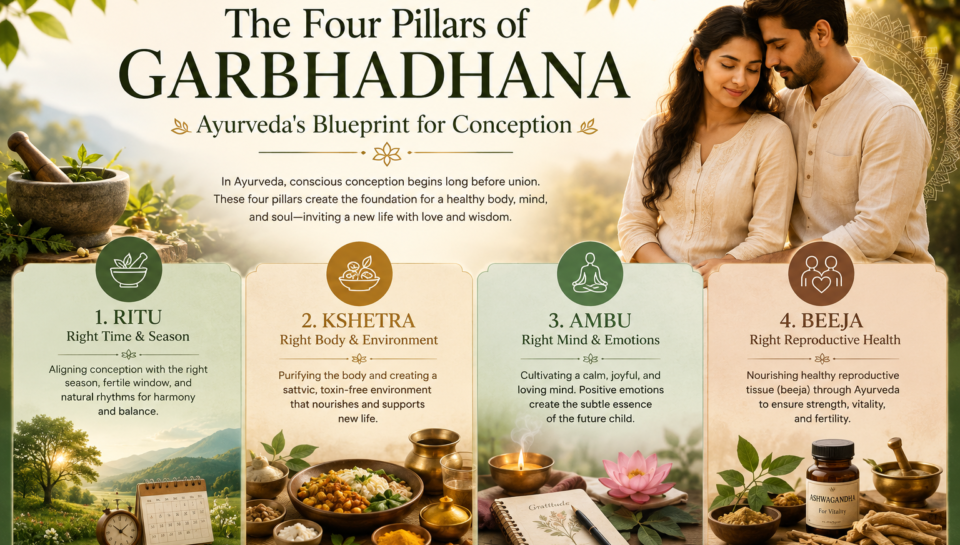
What Sushruta knew 2,000 years ago that modern fertility science is only beginning to confirm
The miracle of conception is not a matter of chance. According to the great surgeon-scholar Acharya Sushruta, the formation of a new life — Garbha — depends on the precise and simultaneous presence of four sacred elements. This ancient insight, encoded in a single verse of the Sushruta Samhita over two millennia ago, anticipates what modern reproductive medicine now calls the “optimal conception window.”
The verse uses a profound agricultural analogy: just as a seed sprouts only when the season is right, the soil is fertile, water is abundant, and the seed itself is potent — so too does human life begin only when all four biological conditions align perfectly.
The Four Pillars of Conception: Ritu, Kshetra, Ambu & Bija
Sushruta’s verse in Sharira Sthana 2/33 is deceptively simple yet profoundly layered. The word dhruvam — meaning “certainly” or “without doubt” — signals that Sushruta is stating a physiological law, not a spiritual metaphor. Let us unpack each of the four pillars:
Ritu
Kshetra
Ambu
Bija
Dalhana’s Commentary: Unlocking the Deeper Science
The 12th-century scholar Dalhanacharya, whose commentary Nibandhasangraha is the authoritative gloss on Sushruta Samhita, provides critical clarifications that expand the clinical utility of this shloka. His commentary identifies five sub-components through his exegesis:
The Agricultural Metaphor: Ancient Intelligence, Timeless Truth
Sushruta’s choice of an agricultural analogy — aṅkuro yathā (just as a sprout) — is not poetic decoration. It is a precise scientific model. Ancient Ayurvedic teachers observed that successful germination requires the simultaneous fulfilment of all four agricultural conditions:
A seed planted in the wrong season withers. A healthy seed in barren soil never takes root. Abundant water without a seed is meaningless. And the finest soil in perfect season cannot compensate for a dead or diseased seed. The same logic applies, with identical precision, to human conception.
This systems-thinking approach to fertility — where the whole is far more than the sum of its parts — is the foundational philosophy of Ayurvedic Garbhavijñana (embryology).
Modern Parallels: Where Ancient Wisdom Meets Reproductive Medicine
The convergence between Sushruta’s framework and contemporary reproductive endocrinology is remarkable:
| Ayurvedic Concept | Modern Equivalent | Clinical Significance |
|---|---|---|
|
Ritu (fertile season) |
Ovulation window, LH surge |
Timed intercourse, ovulation tracking |
|
Kshetra (uterus) |
Endometrial receptivity, uterine anatomy |
Endometrial thickness, polyps, fibroids |
|
Ambu (Rasa Dhatu) |
Nutritional status, hormonal milieu, blood supply |
Maternal nutrition, blood flow to endometrium |
|
Bija / Shukra (sperm) |
Sperm count, motility, morphology |
Semen analysis, male factor infertility |
|
Bija / Artava (ovum) |
Egg quality, ovarian reserve (AMH) |
IVF response, age-related fertility decline |
Clinical Implications: Ayurvedic Management of Infertility
The framework of Ritu-Kshetra-Ambu-Bija provides a diagnostic and therapeutic roadmap. When conception fails to occur, Ayurvedic physicians systematically assess which of the four pillars is deficient or imbalanced — and direct treatment accordingly.
The framework of Ritu-Kshetra-Ambu-Bija provides a diagnostic and therapeutic roadmap. When conception fails to occur, Ayurvedic physicians systematically assess which of the four pillars is deficient or imbalanced — and direct treatment accordingly.
Ayurvedic Uttarabasti (medicated intrauterine instillation), Yonipichu (vaginal tampons soaked in medicated oils), and Kshetra-rasayanas are prescribed to improve uterine receptivity, tone the endometrium, and address structural abnormalities through conservative management.
Since Ambu is the product of Agni (digestive fire) acting on food, restoring Ambu begins with correcting digestion. Ahara (diet) rich in Ojas-building foods — whole grains, ghee, milk, dates, almonds, and seasonal fruits — forms the foundation of Ambu therapy. Formulations like Chyawanprash and Ashtachurna are classically indicated.
For male fertility, Vajikarana (aphrodisiac) therapy using Ashwagandha, Kapikachhu, and Gokshura is employed to improve sperm quality, motility, and quantity. For female Bija (Artava), Rajah Pravartini Vati, Kumaryasava, and Shatavari kalpa are indicated.
Why This Shloka Matters Today
In an era of rising infertility rates, hormonal disorders, and unexplained subfertility, Sushruta Samhita’s Su. Sha. 2/33 offers something that modern medicine often struggles to provide: a unified, patient-centered framework that addresses the whole person — her nutrition, her hormonal rhythm, her uterine health, and the quality of both partners’ reproductive contributions.
The shloka does not separate body from nourishment, or biology from lifestyle. It sees conception as a holistic event requiring alignment across multiple physiological systems — a perspective that is increasingly validated by integrative fertility research worldwide.
For practitioners of Ayurveda, this verse is not merely academic knowledge. It is a clinical compass — guiding the assessment of every couple who seeks help in their journey toward parenthood.
Conclusion: The Seed of Life Requires Perfect Ground
Dhruvam — certainly, without doubt — Sushruta declares. This certainty is the confidence of a physician who understood life not as a random biological event but as the convergence of conditions that can be understood, optimized, and supported.
The next time you encounter a patient struggling with fertility, remember the sprout and the seed. Ask: Is the season right? Is the field prepared? Is the water abundant? Is the seed potent? When all four are present in their fullness, life — as Sushruta knew — will certainly arise.